
Waste management: What if the real cost lies in your operating model?

A few months ago, we explained why the traditional waste management model costs businesses more than they realize: it creates a structural conflict of interest with the carrier, uses RFPs to optimize an inefficient model rather than challenging it, and leaves organizations with little visibility into the waste it generates.
This finding reflects a broader, measurable trend. According to Deloitte’s Global Outsourcing Survey (2024), 80% of executives plan to maintain or increase their investment in third-party outsourcing over the coming years, while half now delegate functions once considered too strategic to outsource. Meanwhile, the recycling and materials management services market is projected to grow from US$68.7 billion in 2025 to more than US$119 billion by 2035, partly driven by the rise of outsourced management models and the growing adoption of circular economy practices.
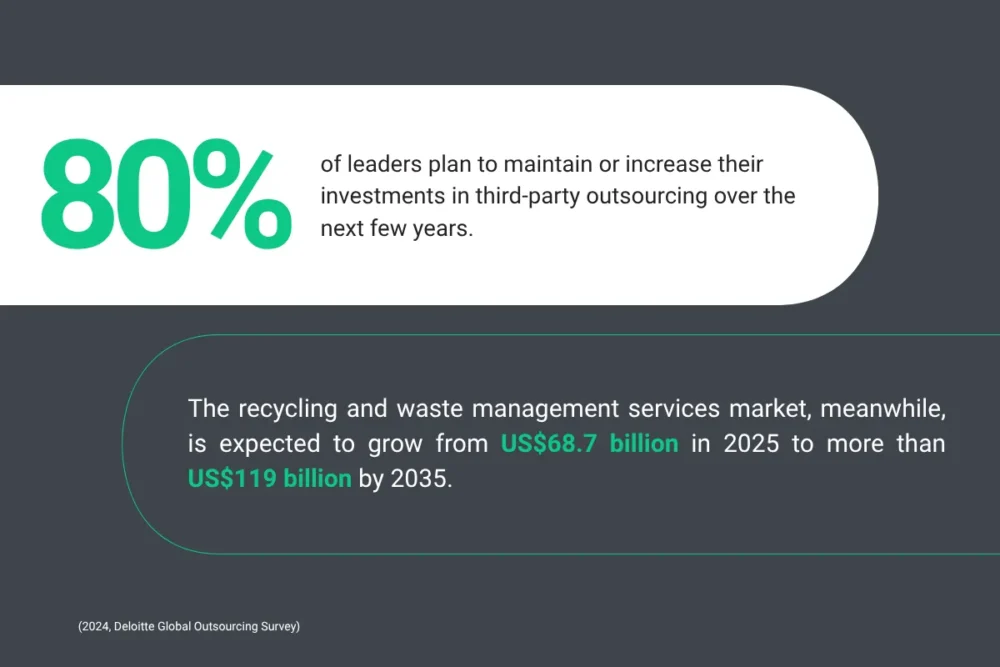
No statistic isolates the proportion of businesses that outsource their waste management to a third party; the sector is simply too fragmented for precise tracking. Still, the direction is clear: businesses increasingly delegate functions once considered too sensitive to outsource, and waste management is no exception to that logic.
The question is no longer whether businesses should rethink their model, but which external model to choose, and that’s where the nuance lies.
The real cost of managing it in-house
The carrier’s invoice is only the tip of the iceberg. Every collection contract also carries an administrative burden that few businesses measure correctly.
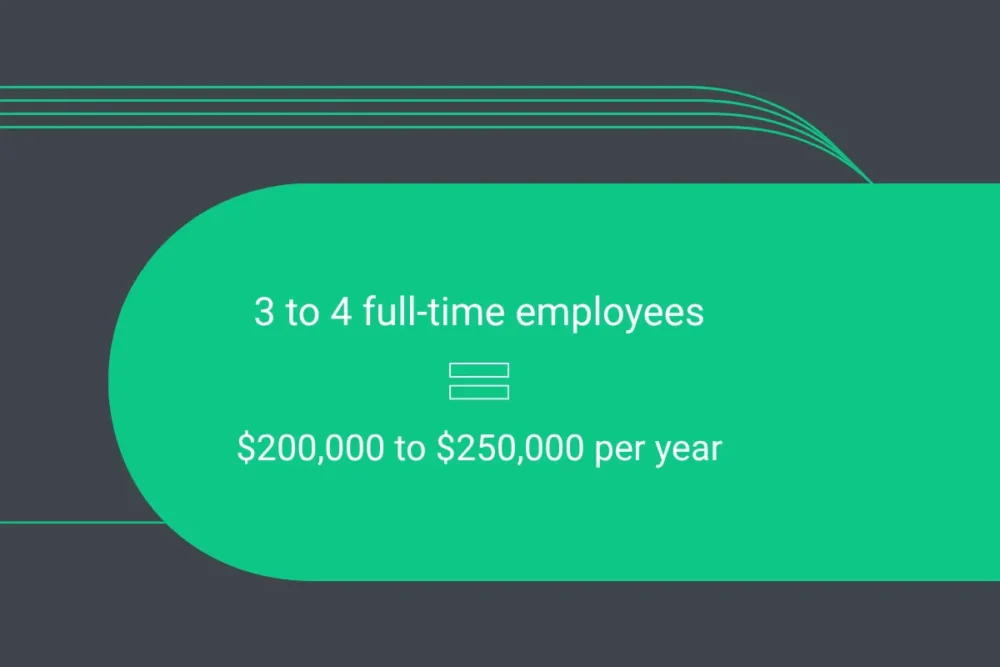
Consider a representative case: a company operating roughly a hundred sites and directly managing fifteen independent collectors Administering that relationship alone typically requires the equivalent of 3 to 4 full-time employees (managing missed pickups and overflows, processing and validating invoices, disputing surcharges, tracking contract renewals, collecting diversion data for sustainability reporting). At a typical salary for an administrative role, that easily represents $200,000 to $250,000 a year in internal costs that never appear on the “waste management” line of the budget.
There is a more insidious risk layered on top: a dependence on institutional knowledge. Waste management runs largely on memory that’s never been documented, such as:
- The right contacts at each supplier
- Each site’s specific requirements
- The history of supplier negotiations
When the person holding this information leaves the organization, this knowledge often leaves with them. A replacement must relearn the role and rediscover the same inefficiencies, restarting the cycle, often just as a contract comes up for renewal and the business enters negotiations from a weaker position.
Businesses that consolidate this function with a single partner report reducing several hundred monthly invoices to a single bill. This isn’t only a matter of administrative convenience: every unreconciled invoice can conceal a financial leak (such as an undisputed surcharge, a rate that no longer matches the signed contract, or payment for a service that was never delivered).
A structural expertise gap, not a lack of effort
No manufacturing, distribution, or retail company was founded to master waste management. It isn’t anyone’s core competency, which is precisely the problem. The responsibility typically falls to someone juggling many other tasks, without specialized training, insight into evolving recyclable material markets, or the negotiating leverage of a player managing comparable volumes across hundreds of clients.
This reality is compounded by growing regulatory complexity. Requirements differ by province, hazardous and specialized materials carry strict traceability obligations, and generators remain legally liable even when collection is subcontracted. A classification or manifest error isn’t just an administrative problem: it creates a real legal and environmental risk for the business.
Adding to this is a more recent pressure: ESG disclosure. Waste diversion data, once relegated to an optional paragraph in annual reports, is increasingly expected and sometimes required, by investors, business partners, and regulators in certain sectors. Producing reliable and defensible data requires a level of tracking that an in-house model, built on emails and spreadsheets cannot sustain over the long term.

Not all third parties are equal
This is where nuance becomes essential, because “outsourcing management to a third party” covers three very different models, and only one of the three truly solves the underlying problem.
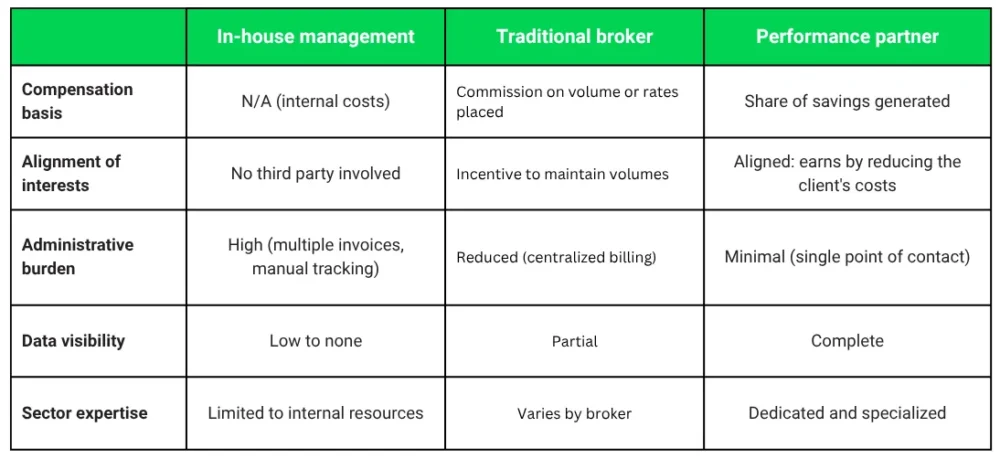
- In-house management remains the starting point for most mid-sized businesses. It appears to offer control, but it also leaves the company responsible for all the hidden costs described above.
- The traditional broker addresses part of the problem by reducing the administrative load, negotiating better rates through aggregated volume, and centralizing billing. This is a real improvement over the status quo. But it’s worth being clear-eyed about its business model: many brokers earn commissions based on the volume or rates placed with their carriers. The conflict of interest isn’t eliminated; it is simply moved up a level, often without giving the client full visibility into this compensation structure.
- The performance partner, by contrast, ties compensation to the savings generated for its client, not to the volume of materials transported or landfilled. This structure, often built on a shared-savings model (for example 50/50) over the contract term, directly aligns both parties’ interests: the partner has no incentive to keep volumes or collection frequencies artificially high, since its revenue depends on reducing them. This independence is what distinguishes genuine operational transformation from administrative subcontracting.
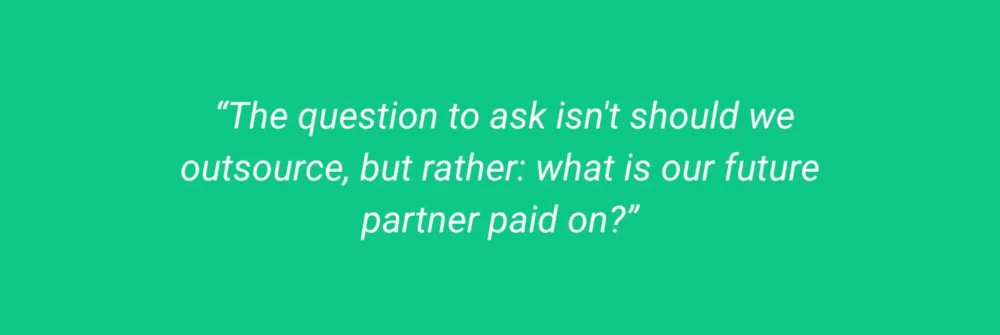
For an executive weighing these options, the key question to ask is not “should we outsource?” but “how is our prospective partner paid and does that model align with ours?”
Why the status quo gets more expensive over time
Many organizations recognize these challenges yet continue issuing another RFP every 3 to 5 years on their existing structure.
The problem: this approach improves pricing within an inefficient model without questioning its architecture. Rates negotiated at signing then gradually erode through indexation clauses, fuel surcharges, and automatic renewals that few internal teams have time to scrutinize.
Meanwhile, organizations that adopt a structurally different model pull further ahead: they gain accurate data on their materials, respond without friction to their stakeholders’ sustainability requests, and free internal teams to focus on priorities that move the business forward.
These signs generally indicate that an organization is ready to rethink its model:
- No one can state the organization’s total waste management cost costs
- Invoices come from multiple suppliers on different schedules and in different formats, without any consolidation
- As contract renewal approaches, the reflex is to ask for new pricing rather reconsider the structure
- Sustainability reporting relies on estimates instead of measured data
- Waste management is added to someone’s primary role despite a lack of specialized expertise
- The business operates multiple sites without a consolidated view across them
If two of these statements apply, the current model likely costs more than the invoice suggests.
What to look for in an external partner
Waste management providers are not alike. The following criteria help distinguish a true strategic partner from another intermediary:
- The compensation structure should be verifiable, not merely claimed during the sales process
- Operational integration should provide one point of contact, one contract, and consolidated billing, not add another layer of coordination on top of existing complexity
- Verifiable client references and documented results achieved in comparable organizations carry more weight than any commitment made during the sales phase
- Industry expertise in the business’s vertical(s) (food and beverage, manufacturing, distribution, healthcare) helps a partner to identify opportunities a generic approach may overlook.
The real decision criterion
The shift toward outsourced management models is no longer an emerging trend: it’s becoming the norm for mid-sized organizations that take operational optimization seriously. But not all outsourcing is equal, and the difference comes down almost entirely to one factor: what is the chosen partner paid on?
Curious where does your organization stand against these signals?