
The Volume Myth: What Actually Determines the Cost of Your Waste Management
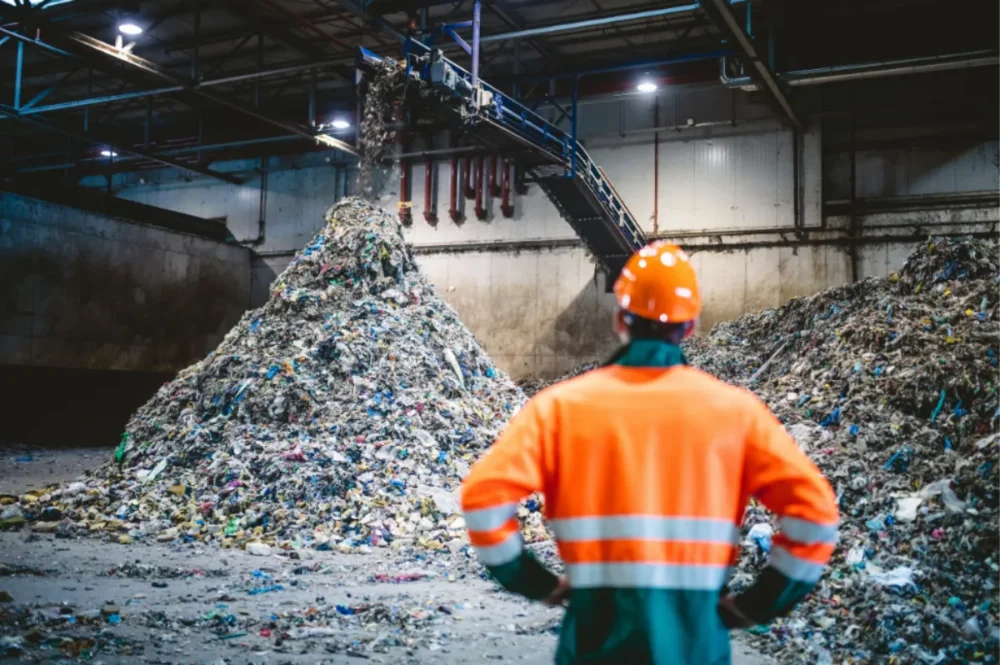
Almost every executive evaluating their waste management (WM) asks the same question: “Do we generate enough volume to make this worth examining?” It’s a fair question, one shaped by how we’re trained to think about industrial costs: more volume, more room to manoeuvre; less volume, less reason for executive attention.
This intuition isn’t wrong. It’s simply incomplete. And in a field where the monthly invoice reads like just another line item, an incomplete intuition can quietly cost a company money for years without ever being questioned.
The reality, after 15 years analyzing the cost structure of waste management for mid-sized companies across Canada, is more nuanced: volume is one factor among several, and rarely the most decisive one. What weighs most heavily on a WM invoice is the interaction of the following three elements:
- The structure of the contractual agreements in place
- The disposal method chosen for each type of material
- The number of different materials a company generates
This last factor is one that most organizations never explicitly consider, and for good reason: volume takes up all the space in how we think about this expense line.
Why Volume Is the Most Intuitive, and the Most Misleading, Metric
Volume is an appealing metric because it is simple, visible, and easy to compare. It appears on invoices, is reported in metric tonnes in sustainability reports and is often the first figure a buyer instinctively asks a potential supplier about to gauge whether an opportunity is “worth” bidding on. Volume has become, more by habit than analysis, the universal proxy for the scale of a waste management issue.
The problem is that volume measures the quantity of material generated. It says nothing about the complexity of managing it, the efficiency of the contract governing it, or the appropriateness of the disposal method used. Two organizations can generate identical tonnage and face completely different financial realities, because tonnage only tells a fraction of the story.
This is especially true for mid-sized companies, often with 50 to 500 employees and multiple sites, that may assume their volumes are “too small to bother with.” Yet these are the organizations that accumulate the most blind spots when this expense line receives limited attention: contracts renewed by default, disposal methods inherited from a historical supplier rather than chosen strategically, as well as material streams that multiply unnoticed because no one is tracking them.
The first of these blind spots, and often the costliest one in a WM cost structure, is found in the contract itself.

Contractual Agreements: The First Blind Spot
The collection contract is, for the vast majority of organizations, a document signed once and forgotten until renewal, often negotiated by whoever handled purchasing at the time of signing and rarely reviewed afterward. This is a structural problem, not a lack of individual diligence: waste management is almost never anyone’s top priority within an organization, which makes it a natural candidate for contractual inertia.
That inertia carries a direct cost. Pricing negotiated five years ago reflects the volumes, operational needs, and market prices of that period, not today’s. A collection frequency calibrated for a past level of activity (growth, contraction, a new production process, an added shift) may no longer fit current operations. The result: either unnecessary collection surcharges, or overflows that create their own operational problems. And the absence of any tracking mechanism for diverted materials (recycling, recovery, reuse) often means an organization is paying for standard disposal service on materials that could generate revenue or, at the very least, a significantly lower disposal cost.
The real test of a contract’s relevance is never the volume it covers. It’s how well that contract aligns with the organization’s current operational reality. A small account with a poorly structured contract leaves as much, if not more, money on the table as a large, poorly structured one, because the percentage of inefficiency is independent of scale. This is precisely why the right question is never “Do we have enough volume to justify a review?” but rather “How long has it been since we checked whether our contractual structure still reflects our reality?”
The contract, however, is only part of the equation. What happens once the material is collected matters just as much.

Disposal Method: A Strategic Choice, Not an Administrative One
The second factor is the disposal method assigned to each material stream, an issue often treated as an operational detail rather than a strategic decision. Landfilling, sorting for recycling, energy recovery, specialized treatment: these are not interchangeable choices. Each carries a distinct cost structure, environmental footprint, and logistical requirements.
A common trap is default disposal: a material that could be recovered continues to be landfilled simply because that has always been the practice, or because no one has checked whether an alternative exists in the market serving that site. Conversely, some organizations may pay for sorting or specialized treatment on materials when a simpler, lower-cost method would be more appropriate.
What makes this factor particularly insidious is that it’s rarely visible on an invoice. A collection invoice may show the volume collected and the price paid, but not why a given material was sent to one destination instead of another, or whether that destination remains the most advantageous given shifts in the recyclable materials market, regional treatment capacity, or newly emerging recovery streams. Without a dedicated analysis of this question, an organization can pay for a suboptimal disposal method for years without ever realizing it.
Yet there’s a third, less obvious factor often explains most of the gap between organizations of comparable size.
Material Diversity: The Invisible Factor That Weighs the Most
This is where the volume intuition collapses more clearly. The factor that often has the greatest impact on the real cost of waste management isn’t the quantity of material generated, but its diversity.
Let’s consider two fictional organizations, for illustration.
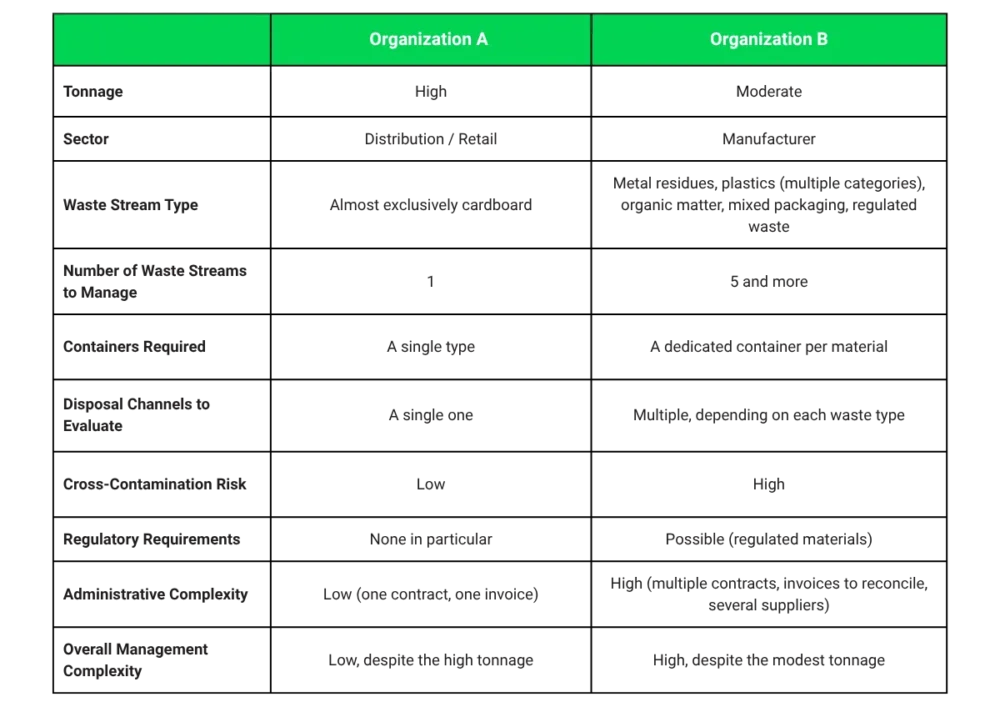
The first generates significant tonnage, but almost exclusively a single material, for example cardboard, in a distribution or high-volume retail context. Despite the scale of the tonnage, its management remains simple: one stream to optimize, one type of container, one collection frequency to adjust, one disposal channel to evaluate.
The second organization generates a much more modest tonnage but operates a manufacturing process that simultaneously produces metal residues, several categories of plastics, organic material, mixed packaging, and potentially materials requiring regulated handling. Despite a lower total volume, this second organization faces operational complexity and a cost structure that far exceed what its overall tonnage would suggest.
Every additional material stream introduces its own requirements: a dedicated container, a collection frequency tied to how quickly it’s generated, a specific supplier or disposal channel, and a risk of cross-contamination when source segregation isn’t rigorous. If the material is regulated, it may also carry distinct compliance requirements. Administrative complexity increases accordingly: more contracts to monitor, more invoices to reconcile, more supplier relationships to manage, and more hidden inefficiencies to uncover.
This explains why two organizations of comparable size, operating in different sectors, can face waste management challenges that are disproportionate to their respective volumes. A manufacturer or healthcare organization, for example, will typically generate a far greater diversity of materials than a multi-site retailer with comparable volume. That material diversity, far more than the tonnage alone, is often what defines the true scale of the optimization potential.
What This Means for Decision-Makers
This nuance has a direct impact on how an executive should approach this expense line, and on their ability to reduce waste management costs. If volume is the only criterion for relevance, it’s easy, and seemingly logical, to push waste management to the bottom of the priority list when tonnage is modest. But if the true cost driver is the combination of agreements in place, disposal methods chosen, and the diversity of materials generated, then the question is no longer whether the organization has a volume problem. It’s how long it’s been since these three elements were evaluated together, rigorously and on their own merits.
This is precisely the reflex most often missing in mid-sized organizations: waste management is treated as a procurement exercise. Pricing is requested against the same structure every three to five years, quotes are compared on the same basis, and the file is considered resolved as soon as a new price, usually only marginally lower, is secured. This exercise never asks the one question that matters: is the structure itself (contracts, disposal methods, management of material diversity) still suited to the organization’s current reality?
Repeating the same competitive bidding process against an outdated structure does little more than renegotiate inefficiency at a slightly different price. Analyzing, restructuring, optimizing, and transforming that structure, rather than simply putting it back out to market, is what allows an organization to capture value that traditional procurement, by design, can never reveal.
The S3R Approach: Mapping Before Optimizing
This is why any serious approach must begin with a complete mapping of the current situation rather than immediate negotiation. An analysis focused solely on volume and price per tonne misses the point entirely. A rigorous analysis must simultaneously document actual volumes by site and material, the structure and terms of existing agreements, the disposal methods assigned to each stream, and the degree of material diversity across all operations.
This is the approach S3R applies systematically, as an independent performance partner rather than a waste collection provider. That independence is not a minor detail: because S3R isn’t compensated based on tonnage transported or landfilled, its recommendations are driven solely by the client organization’s actual needs, free of any conflict of interest over the disposal method or contractual structure proposed.
Our business model, a partnership based on sharing the savings generated, with no financial risk to the client, directly aligns our interest with the client’s: the more real and lasting the optimization identified, the greater the value generated for both parties.
This approach applies equally to the high-volume, single-material company and to the one operating with modest tonnage but high material diversity. In both cases, the question is never “Do you have enough volume?” but “Do you actually know the true structure of your cost, and whether it’s still optimal?”

Challenging the Status Quo of Your Waste Management
Volume will always matter, suggesting otherwise would be unrealistic. However, when it is treated as the only measure of whether a WM review is worthwhile, many mid-sized organizations overlook a cost category whose true impact is masked behind the apparent simplicity of a tonnage figure.
The question is not “Do we generate a large volume of waste?” but “Do we actually know what, within our current structure (contracts, disposal methods, material diversity), determines our true cost?” For most executives, the honest answer is no. This lack of visibility, far more than volume itself, is often the largest and most overlooked opportunity for optimization.
That’s exactly what a rigorous, independent mapping process reveals.
Wondering where your organization stands? The S3R team can help you build a complete picture of your current reality and determine, independently, whether your waste management structure still aligns with your needs: https://s3r.ca/en/contact/